Note: This paper was originally developed and submitted as part of the Master in Education coursework at UPOU
A WebQuest for 5th Grade Elementary Level (Science and Technology)
Designed by
Jane Nakayama
learnwithme1212@gmail.com
A. Introduction
Have you ever wondered what the future of transportation would look like? With congested roads and frequent road accidents due to the massive number of cars on the streets, do you think we will see cars flying in the sky twenty years from now instead of cars on the roads? These are just a few questions that come to mind when we discuss transportation.
In this activity, you will act as future engineers tasked with designing a flying car prototype and a policy for public use. According to SkyDrive, flying cars will shape the future of society (Sd, & Sd.,2025). As future engineers, you will engage with your group members to develop an exciting product that could be considered as the new mode of transportation in the future.
Get yourself ready for a challenging activity as we dive into the new future of transportation!
The Task
You will design a flying car prototype through sketches, any digital tools such as Canva or PowerPoint, or a paper model. Aside from designing the prototype, you will also create a policy for safety regulations and air traffic control protocol.
The Process
To fulfill your task in designing your unique flying car prototype, refer to the following steps.
You will be assigned to a team of four students. Introduce yourselves to each other and together decide on the role each of you should take. The roles are:
Lead engineer
The lead engineer is responsible for the technical design of the flying car prototype. He/She will work hand in hand with the material analyst for design feasibility.
TASK: The lead engineer and the materials analyst need to create a sketch or digital mockup of the car.
Materials analyst
The materials analyst creates the structure of the car as well as its feasibility. He/She will research materials to be used in cars and even for aircraft to determine the most feasible materials to utilize.
TASK: The material analyst should write a short report on materials and mechanical feasibility.
Policymaker
The policymaker focuses on creating a set of rules, such as for safety regulations and air traffic control protocol.
TASK: The policymaker should write a one-page policy document or infographic showing the set of rules for flying cars.
Social and Environmental Analyst
The environmental analyst researches the impacts of flying cars on society and the environment. He/She analyzes social and environmental issues and then proposes solutions to tackle them.
TASK: The social and environmental analyst writes a reflection essay or a visual chart showing the social and environmental impacts of flying cars.
Once you’ve picked a role to play, begin to work on the duties assigned to you. The time allotted for each role is 2 days. At the end of the 3rd day, you should gather and present your work within your group. You will analyze each member’s output. Then, once this process is done. The group will compile their work as a team and get ready for a class presentation.
You will present your flying car prototype in class along with your policy.
You will be given a chance to present your work based on your role.
At the end of your presentation, you will assess the other group’s presentation based on the rubric provided. (See Appendix I)
On the other hand, after the peer assessment, you will assess yourself as well. (See Appendix II and Appendix III)
B. Resources
To accomplish the task of designing a flying car prototype, refer to the following resources:
Web resources
Samson Sky
samsonsky.com/
SkyDrive
SkyDrive Inc.
Joby Aviation
Joby Aviation
YouTube videos
Best 2-Seater Flying Cars 2025 | TOP 15 VTOL AirCars
Futuristic Chinese Flying Car! | Xpeng AeroHT
Online articles
SkyDrive Starts Summer Demonstration Flights at Expo 2025 in Osaka
Suzuki and SkyDrive Start Manufacturing of Flying Cars in Iwata, Shizuoka | GLOBAL NEWS
Flying cars: transforming a dream into reality
The 13 Engineers Leading the Way to the Flying Car
B. Resources for each role: The resources for each role are provided below:
Lead engineer
Engineers get closer to making flying cars a reality
Flying Cars and the Future of Civil Transportation – USC Viterbi School of Engineering
Engineers design battery to power flying cars – UPI.com
Material analyst
Why advanced materials are more exciting than flying cars
Advanced Materials for Flying Cars Market Growth Industry 2033
Advanced Materials for Flying Cars Market Size & Share, 2031
Policymaker
Potential Policy Issues with Flying Car Technology – ScienceDirect
What are the rules for flying cars? – Samson Sky
What are the rules for flying cars? – Samson Sky
Social and environmental analyst
Flying Cars Will Undermine Democracy and the Environment – Center for American Progress
Role of flying cars in sustainable mobility | Nature Communications
CO2 emissions from electric flying cars: Impacts from battery specific energy and grid emission factor – ScienceDirect
C. Interview: To gain more knowledge from experts and to directly ask them questions, refer to the following names and contact them through email or their personal social media accounts.
Samson Sky
Name: Sam Bousfield (CEO)
Website: samsonsky.com/
Email: samb@samsonsky.com
SkyDrive
Name: Tomohiro Fukuzawa (CEO)
Website: https://en.skydrive2020.com/
LinkedIn: linkedin.com/in/tomohiro-fukuzawa-85715a176
To guide everyone during the interview, refer to the possible questions you can ask to gain more information that you can consider to complete your task.
How are flying cars made?
How can flying cars help our society?
What do flying cars use for power: a battery, motor, or engine?
Who can drive a flying car? Do you think drivers should have a special license to drive a flying car?
Can flying cars be the ultimate answer to traffic congestion?
How much will it cost to make a flying car?
What kind of metal do you use for the body of a flying car?
How do engineers design the flying car? Is it the same with ordinary cars and airplanes together?
Once flying cars are regulated, do you think we need special parking lots where only flying cars are allowed to park?
Do you think flying cars will be available for people of different ages and social status?
If we are interested in flying cars, what course should we enroll at the university?
What field of engineering does flying cars belong to?
How do you invite the young learners to get involved or draw interest in flying cars?
Will the people be ready for the next generation of transportation?
Guidelines on how to accomplish the task. Please refer to the following steps:
Designing the Future of Transportation
Step 1: Form Your Team
Create a group of 4 students.
During the 1st brainstorming session, each student will be assigned a role that best matches their interests.
Lead Engineer
Materials Analyst
Policy Maker
Environmental & Social Analyst
Step 2: Understand how to accomplish your task
As a team, your goal is to design a realistic flying car prototype and propose policies that support its safe, legal, and eco-friendly use in the future.
Your final presentation should include:
A flying car design (sketch, model, or digital drawing)
A one-page written or visual policy document
Environmental and social impact findings
A group presentation (poster, slides, or video)
Step 3: Research your assigned role
Each member completes their task using reliable resources (videos, articles, and websites provided in the WebQuest).
Lead Engineer
Research how flying cars work (design, power source, lift, and flight).
Create a detailed drawing or digital model of the flying car.
Materials Analyst
Research what materials (e.g., carbon fiber, aluminum) would be best for your flying car.
Explain why these materials are safe and efficient.
Write a brief feasibility report to be presented to your group (half a page to one page).
Policy Maker
Investigate how flying cars might be regulated.
Create a 1-page policy outline: who can fly, where, how, and under what conditions.
Environmental & Social Analyst
Research environmental impacts
Explore how flying cars could affect our society
Create a short visual chart or reflection report. This will be included in your final presentation.
Step 4: Collaborate as a Team
Share your findings with the group
Help each other to generate and refine ideas
Work together to build your final flying car prototype
Plan your presentation
Step 5: Create the Final Project
Your group must prepare:
A flying car prototype (drawn, 3D paper model, or digital mockup)
Policy document or infographic
Environmental/social report or visual
Group presentation (poster, Google Slides, video)
Note: Each group may opt to use FlipGrid to create a video presentation.
Step 6: Present your flying car prototype in an audience
Share your project with your classmates and teacher.
Each group member should explain their role and contribution.
Be ready to answer questions as a team of future engineers.
Note: The presentation can be done inside the grade 5 classroom or invite other grade school students to watch all the presentations.
C. Learner Scaffold
Reception Scaffold
Interview Questions : Students will interview someone who owns a flying car company or someone who is related to creating a flying car. A list of questions is made for you to use during the interview. Before the interview, ensure that you contact the person in charge and schedule a video call. In addition, also ensure that all the group members are present. After the interview, send an email to the person you interviewed and thank them for their time and effort.
Each student will be given a copy of the interview questions.
Please refer to the interview questions below.
Transformation Scaffold
Mind map – During the 1st brainstorming session, a mind map will be given to each group. Each group may choose to access this link :Mind Map – Designing the Future of Transportation or may opt to choose to write their ideas on the template provided below:
D. Evaluation
Appendix I
Flying Cars WebQuest – Rubric
Group Assessment
Flying Cars WebQuest: Self- Assessment
Date: __________
Group:_________
Name:_________
Criteria
Exceeds Expectation
5 points
Meets Expectation
4 points
Needs Improvement
3 points
Below Expectation
2 points
Content
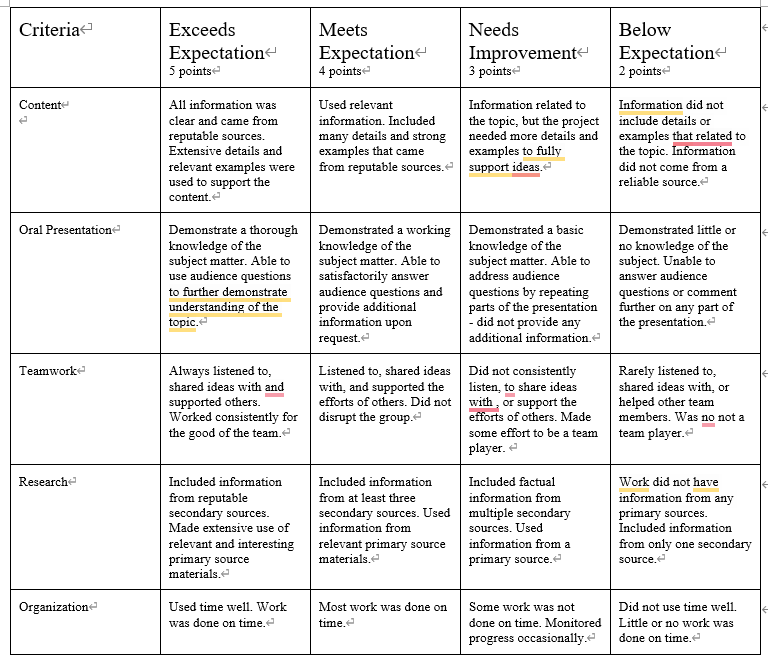
The perfect score for the Group Assessment is 25 points. Each student will assess each group’s work and presentation based on the rubric provided above.
Appendix II
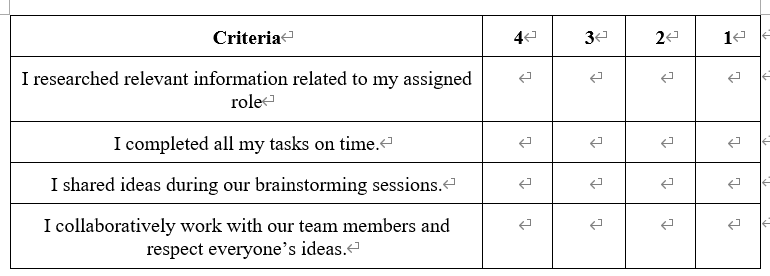
Self-Assessment
Flying Cars WebQuest: Self- Assessment
Name:
Group:
Role in the group:
Date:
4 = Always/ 3 = Often / 2 = Sometimes / 1 = Rarely
Appendix III
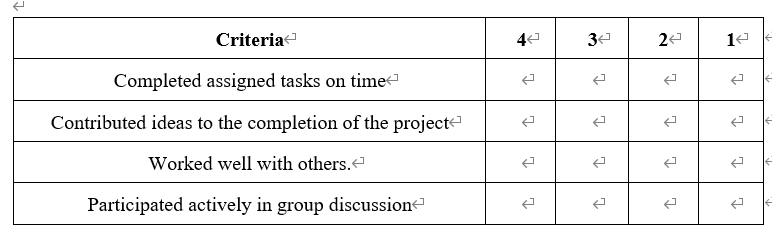
Peer-Assessment
Flying Cars WebQuest: Self- Assessment
Name:
Group:
Role in the group:
Date:
4 = Always/ 3 = Often / 2 = Sometimes / 1 = Rarely
Criteria
4
3
2
1
Final Grade Computation for Flying Cars WebQuest
1. Group Assessment (50%)
This grade measures the quality of the final product (prototype + policy + presentation).
Criteria (from rubric): content, oral presentation, teamwork, research, organization
2. Peer Assessment (30%)
This grade reflects how well each student contributed and collaborated.
Each group member assesses the others.
The teacher averages the peer scores for each student.
3. Self-Assessment (20%)
This grade shows how the student assesses how well she/he contributed to the success of completing the group tasks.
Sample Formula
Final Grade = (Group Assessment × 50%) + (Peer Assessment × 30%) + (Self-Assessment × 20%)
Conclusion
In this WebQuest, students take on the role of future engineers who are tasked with designing a flying car prototype and creating a policy for its safe public use. Students working in groups of four, each member is assigned a role such as lead engineer, materials analyst, policymaker, and social and environmental analyst based on their best interests.
The Flying Car WebQuest has been a challenging and exciting journey for students. Through this activity, students not only enhance collaboration skills as they have to share ideas with fellow group members, but also foster creativity, innovation, and critical problem-solving skills that are essential for the 21st century.
Furthermore, this WebQuest encouraged students to think beyond technology but also consider the social and environmental impacts of flying cars as a new mode of transportation.
In conclusion, this WebQuest is a holistic learning experience for students as the activity goes beyond memorization. It fosters a deeper learning experience.
References
Sd, & Sd. (2025, July 31). SkyDrive starts Summer demonstration flights at Expo 2025 in Osaka – SkyDrive Inc. SkyDrive Inc. – SkyDrive Inc. https://en.skydrive2020.com/archives/16094.